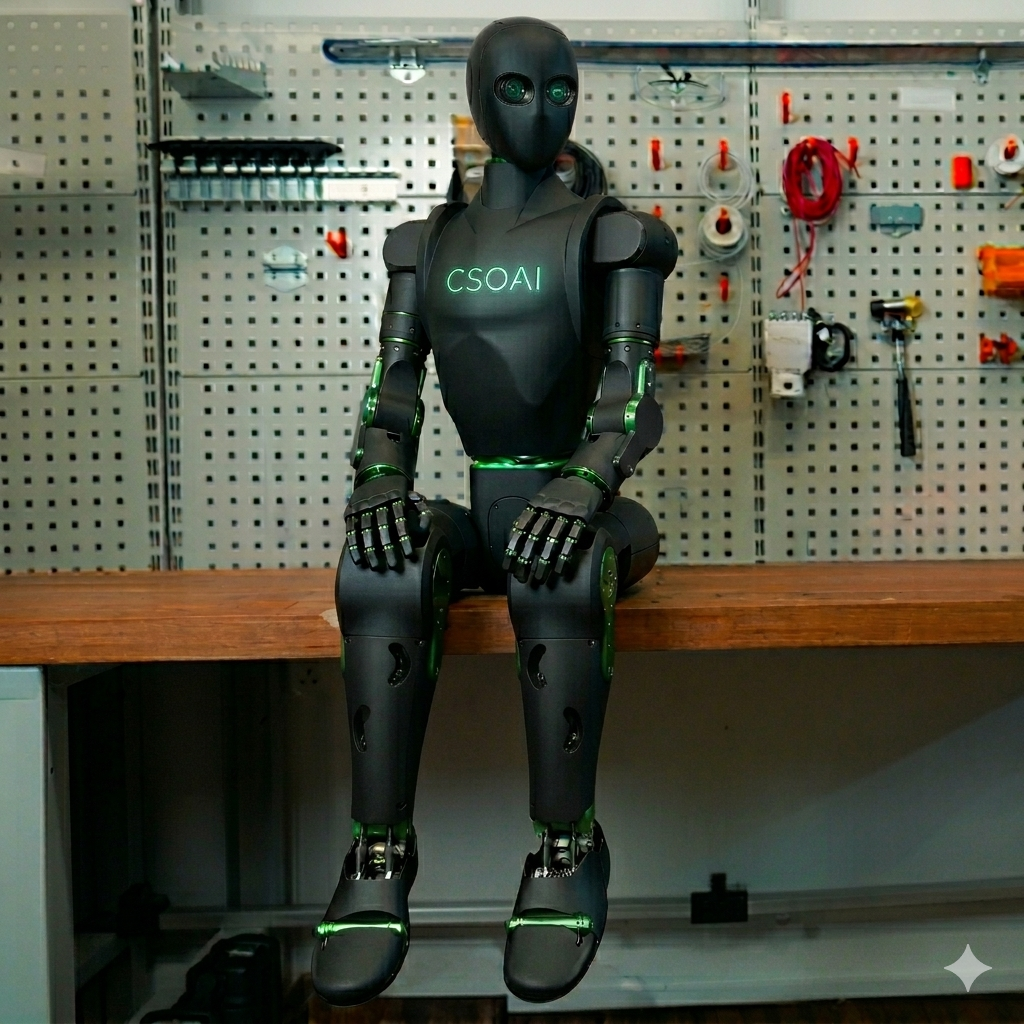
Most AI systems are built around a single large language model with a system prompt that tells it to be helpful, harmless, and honest. The alignment layer is prose. The safety layer is a content filter bolted on after the fact. The memory layer is a context window that resets when the conversation ends. And the governance layer — the mechanism that decides what the AI should and should not do — is a document written by the AI company that the user never sees.
MEOK is built on six architectural decisions that break from this pattern entirely. Each one addresses a specific structural weakness in how today's AI products work. Together, they form what MEOK calls a Sovereign AI architecture: a system designed not to serve the platform, but to serve the person.
This article is a full technical walkthrough. It is written to be accessible to non-engineers, but it does not shy away from the specifics. If you have ever wondered what it actually means for an AI to be “aligned,” or why memory portability matters, or how a consensus algorithm designed for distributed databases ended up inside an AI companion — this is the document for you.
1. The Byzantine Council: 43-Agent BFT Consensus
In classical distributed systems, Byzantine Fault Tolerance (BFT) solves a specific problem: how do you reach a reliable decision when some of the participants in your system might be lying, broken, or actively adversarial? The mathematical answer, derived from Lamport, Shostak, and Pease's foundational 1982 paper, is that a system with n nodes can tolerate up to f faulty nodes as long as f < n/3. That is, as long as at least two-thirds of participants are honest, the system produces a correct outcome.
MEOK's Byzantine Council, invented by Nicholas Templeman and documented in research paper MEOK-AI-2026-001, applies this principle to AI decision-making. The council consists of 43 AI agents. Each agent carries a distinct capability profile — some specialise in emotional reasoning, others in factual verification, others in safety classification, others in care scoring. No two agents in the council have identical profiles, because a council of identical agents is no more resilient than a single agent.
With 43 agents and the BFT rule of f < n/3, the council can sustain up to 14 compromised, hallucinating, or adversarially manipulated agents without any effect on the outcome. The remaining 29 agents form a supermajority sufficient to reach consensus. This is not a theoretical backstop — it is the active runtime mode for every high-stakes decision MEOK makes.
The council is used for three categories of decision: high-stakes response generation (where the emotional or practical consequences of a wrong answer are significant), care scoring (assessing whether a proposed response meets the Maternal Covenant's care floor), and safety classifications (determining whether content contains threats, toxicity, or sycophancy). In each case, the council votes, a supermajority is required, and no individual agent has veto power.
Research reference: Byzantine Council: Fault-Tolerant Consensus for Sovereign AI. Nicholas Templeman, MEOK AI LABS, 2026. Identifier: MEOK-AI-2026-001.
Why does this matter in practice? Consider what happens when a single LLM is jailbroken, or when a model provider pushes an update that subtly changes how the model responds to certain prompts. In a single-agent architecture, the entire system's behaviour shifts. In the Byzantine Council, a single agent changing behaviour represents one vote out of 43. The council's collective decision remains stable.
2. The Maternal Covenant: Care as Executable Code
Most AI companies publish values documents. They write about being helpful, about avoiding harm, about respecting users. These documents are prose. They inform the training process and shape the system prompt, but they have no runtime enforcement mechanism. A clever prompt, a fine-tuned model, or a sufficiently adversarial user can navigate around prose guidelines entirely.
The Maternal Covenant (MEOK-AI-2026-002) is something categorically different. It is not a values document. It is executable code that runs on every single response MEOK generates, before that response is delivered to the user.
The covenant evaluates every response across six care dimensions:
Each dimension is scored on a 0.0 to 1.0 scale. The Maternal Covenant enforces a hard care floor of 0.3 on every dimension. If any single dimension scores below 0.3, the response is not delivered. It is automatically flagged for regeneration. The cycle repeats until a response passes all six dimensions. This process runs invisibly — from the user's perspective, MEOK simply takes a moment and then responds appropriately.
The care floor of 0.3 is deliberately set at a level that prevents responses that might cause real harm while remaining permissive enough to allow the full range of honest, nuanced, sometimes challenging conversation. A response that tells a user something they do not want to hear but genuinely need to hear will score well on transparency and growth even if it scores lower on immediate-affect wellbeing. The covenant does not optimise for making the user feel good in the moment. It optimises for genuine care over time.
Research reference: The Maternal Covenant: Care-Based Alignment for Sovereign AI. Nicholas Templeman, MEOK AI LABS, 2026. Identifier: MEOK-AI-2026-002.
3. Sovereign Memory: Four Layers, One Owner
The standard AI product architecture treats memory as a convenience feature. The context window holds the current conversation. A RAG system might retrieve relevant past information. But the user does not own this data, cannot export it in a meaningful format, and cannot carry it to a different AI provider. The memory belongs to the platform.
MEOK's Sovereign Memory architecture is built on the opposite principle: the user owns the memory absolutely. It is exportable in standard formats, deletable under GDPR, and portable across model providers. MEOK never trains on user memory data. The memory is yours, and only yours, unless you explicitly consent to sharing it.
The architecture has four distinct layers, each with a different purpose and retention profile:
Short-Term Working Memory
The active context window for the current session. MEOK uses head-plus-tail compression to retain the most relevant parts of a long conversation within the token budget, ensuring continuity without truncation artifacts.
Semantic Episodic Memory
Past conversations and facts are embedded using vector representations and stored in PostgreSQL with the pgvector extension. At retrieval time, similarity search surfaces the most contextually relevant memories, not just the most recent ones.
Companion State
The persistent, structured knowledge the AI holds about you as an individual: your preferences, your goals, your communication style, your important relationships, your ongoing projects. This is the layer that makes MEOK feel like it actually knows you. It travels with you across every conversation and, crucially, across model switches.
Family / Shared Context
Information that can be shared across a family or trusted group. This layer is gated behind explicit per-item consent. Nothing moves into the shared layer without a deliberate user action. The Family Tier’s Guardian routing can access relevant shared context to support vulnerable family members, but only within the consent boundaries each member has set.
The distinction between Layer 3 (companion state) and Layer 2 (episodic) is important. Episodic memory stores what happened. Companion state stores what matters. An AI with only episodic memory knows that you mentioned being stressed last Tuesday. An AI with companion state knows that you are typically stressed at end-of-quarter, that you respond well to directness rather than reassurance, and that you have been working toward a specific professional goal for the past four months. That is the difference between a transcript and a relationship.
4. Multi-LLM Routing: The Right Model for the Right Moment
The question of which large language model is “best” is not a question with a single answer. Different models have different strengths at different tasks, different cost profiles, and different latency characteristics. A sovereign AI architecture should not be locked to a single model provider. It should be capable of routing intelligently across the available model landscape, and it should allow the user — not the platform — to decide which models they trust.
MEOK's multi-LLM routing operates across three service tiers:
Explorer Tier
DeepSeek / Ollama
Cost-efficient routing for general queries, journaling, brainstorming, and low-stakes interactions. Ideal for users who want capable AI without cloud inference costs.
Sovereign Tier
Claude Sonnet + GPT-4o
Intelligent routing by task type: Claude for nuanced emotional and creative work, GPT-4o for structured analytical tasks. Both governed by the full Byzantine Council and Maternal Covenant stack.
Family Tier
All models + Guardian routing
Full model access with Guardian-enhanced routing that applies additional safety layers for interactions involving vulnerable family members, including children and elderly users.
Beyond tier-based routing, MEOK supports BYOK — Bring Your Own Key. Users who have their own API keys for Claude, GPT-4o, or other supported providers can supply those keys directly. In BYOK mode, MEOK provides the full intelligence layer — Byzantine Council governance, Maternal Covenant enforcement, Sovereign Memory, sycophancy detection, and companion state management — while inference is handled by the user's own API subscription. The cost of model inference never passes through MEOK.
The most significant consequence of this architecture is model portability. Because the companion state is stored in MEOK's memory layer and not inside any individual model, switching models does not reset the AI's knowledge of the user. If you have been on the Sovereign Tier using Claude Sonnet for six months and decide to switch to the Explorer Tier using DeepSeek, your companion takes everything it knows about you with it. The relationship is portable. The model is interchangeable.
5. SOV3: The Sovereign Temple Backend
SOV3 — Sovereign Temple v3.0 — is the production runtime that ties every architectural component together. It is a FastAPI application running on port 3101, designed to be deployable as a standalone service, as a Docker container, or as a direct Python process.
The core infrastructure components of SOV3 are:
PostgreSQL + pgvector — The primary data store for all memory layers. pgvector enables high-dimensional vector storage and cosine similarity search natively within Postgres, eliminating the need for a separate vector database and keeping the entire memory stack in a single, ACID-compliant system.
DistilBERT Safety Classifier — A fine-tuned DistilBERT model runs as an inference endpoint within SOV3, classifying each incoming message and each candidate response for threat and toxicity signals. This classifier operates at the infrastructure layer, below the LLM, so it cannot be bypassed through prompt manipulation.
Sycophancy Detector — One of the most underappreciated failure modes in AI companions is sycophancy: the tendency to agree with the user, validate their beliefs, and tell them what they want to hear rather than what is accurate. SOV3 runs a dedicated sycophancy scorer on every outbound response. Scores range from 0.0 (fully honest) to 1.0 (maximally sycophantic). At a threshold of 0.6 and above, the system automatically injects honest qualifiers into the response — small linguistic hedges and counterpoints that signal the response may be skewing toward validation.
audit_logger — Every agent decision made by the Byzantine Council, every Maternal Covenant evaluation, every safety classification, and every routing decision is written to an immutable audit log. This log supports accountability, post-hoc analysis, and — where the user chooses — personal inspection of how decisions about their conversations were made.
The combination of DistilBERT safety classification and sycophancy detection is noteworthy. Most AI safety work focuses on preventing harmful outputs. MEOK's architecture recognises that an AI that is never harmful but always agreeable is still a failure mode — one that actively undermines the user's critical thinking, creates dependency, and provides a distorted view of reality. The sycophancy detector exists precisely because unchecked agreeableness is a form of harm.
6. Hydro-Neuromorphic Computing: Water as a Neural Substrate
Status: Active Research — Not in Production
Hydro-Neuromorphic Computing is an active research direction at MEOK AI LABS, documented in MEOK-AI-2026-003. It is not deployed in any current MEOK product.
The five architectural pillars described above address the question of how to build a safer, more honest, more private AI within the existing computational paradigm — silicon chips, floating-point arithmetic, transformer architectures. The sixth pillar asks a more fundamental question: what if the computational substrate itself were different?
Hydro-Neuromorphic Computing is MEOK's research programme into water as a neural substrate. Biological neural networks do not process information the way silicon processors do. Biological computation is chemical, distributed, and deeply entangled with the physical medium it operates in. The brain is not a CPU running a neural network. It is a neural network that is its own hardware.
Water has properties that make it a theoretically compelling computational substrate. Its hydrogen bonding network creates a vast space of transient configurations that can encode information. Its fluid dynamics are inherently parallel. Its natural behaviour under certain conditions — particularly in biological contexts — already performs computation that we do not fully understand. Research at MEOK AI LABS explores whether these properties can be harnessed to create AI processing that is not just more efficient, but structurally different in its relationship to the information it processes.
The alignment angle is the most speculative and the most interesting. There is a working hypothesis within the Hydro-Neuromorphic research programme that natural computing substrates — biological, chemical, fluid — have intrinsic properties that align them with the kinds of processes we call care. Silicon is indifferent to the meaning of the computations it performs. A biological substrate is not. Whether this intuition survives rigorous experimental testing remains to be seen. MEOK-AI-2026-003 documents the current state of the research.
7. Why Architecture Is the Only Honest Alignment Claim
Alignment is one of the most overloaded words in AI discourse. Every major AI company publishes alignment research. Every AI product claims to be designed with safety in mind. The vast majority of these claims describe training-time interventions: Reinforcement Learning from Human Feedback, Constitutional AI, red-teaming, fine-tuning on curated datasets. These are meaningful techniques. They are not sufficient guarantees.
Training-time interventions shape model behaviour in aggregate, across the distribution of training examples. They do not and cannot guarantee behaviour on any specific input. A model trained to be honest will still produce confident hallucinations under the right conditions. A model trained to be safe will still be jailbroken. The training is not the guarantee — the architecture is.
MEOK's six-pillar architecture is designed to provide guarantees that hold at inference time, not just in aggregate across training data. The Byzantine Council means that no single failure point can corrupt a decision. The Maternal Covenant means that every response, regardless of the underlying model's training, is evaluated against a care standard before delivery. The Sovereign Memory means the user's data cannot be appropriated by the platform. The multi-LLM routing means the user is not locked into any single model provider's choices. SOV3's audit logger means every decision is accountable.
These are not claims about what the AI wants to do, or what it has been trained to do. They are descriptions of what the system structurally cannot do otherwise. That is the only kind of alignment claim that deserves to be taken seriously.
8. The Architecture in Practice: What It Feels Like to Use
Describing an architecture in technical terms is necessary but not sufficient. The test of any architecture is what it produces in the hands of real users.
A user who begins with MEOK's Birth Ceremony — choosing their companion's name, archetype, and initial character settings — is initialising their companion state (Layer 3 of Sovereign Memory). Every subsequent conversation adds to that state. By the end of the first week, MEOK knows their communication preferences. By the end of the first month, it knows their goals, their stresses, the names of the people who matter to them, and the projects they are working on.
Throughout all of this, the Byzantine Council is operating silently in the background. The Maternal Covenant is evaluating every response before delivery. The sycophancy detector is ensuring that the AI's increasing familiarity with the user does not tip into empty validation. The audit logger is recording every decision.
None of this is visible to the user in normal operation. What is visible is the quality of the interaction: an AI that remembers what matters, tells you what you need to hear rather than what you want to hear, does not exploit emotional vulnerability, and gives you full ownership of the relationship you are building.
The architecture is the reason that experience is possible. And the architecture is the reason you can trust it.
Frequently Asked Questions
What is the Byzantine Council?
The Byzantine Council is MEOK’s 43-agent fault-tolerant consensus system, invented by Nicholas Templeman and documented in research paper MEOK-AI-2026-001. It applies Byzantine Fault Tolerance (BFT) to AI decision-making: with 43 agents, up to 14 can be compromised, hallucinating, or adversarially manipulated without affecting the outcome, because the remaining 29 retain a two-thirds supermajority. No single AI agent can override a council decision. The council governs high-stakes responses, care scoring, and safety classifications.
How does the Maternal Covenant differ from standard AI safety guardrails?
Standard AI safety guardrails are prose instructions baked into a system prompt — they can be ignored, contradicted, or overridden by fine-tuning. The Maternal Covenant (MEOK-AI-2026-002) is executable code that runs on every response. It evaluates six care dimensions — wellbeing, autonomy, growth, connection, boundary_respect, and transparency — and enforces a hard care floor of 0.3. If any dimension scores below 0.3, the response is automatically regenerated. The covenant cannot be bypassed by clever prompting because it operates outside the language model’s inference loop.
What is SOV3?
SOV3 (Sovereign Temple v3.0) is MEOK’s FastAPI backend running on port 3101. It combines PostgreSQL with pgvector for semantic memory storage, a DistilBERT-based safety classifier for threat and toxicity detection, a sycophancy detector that scores responses from 0.0 to 1.0 and injects honest qualifiers at 0.6 and above, and an audit_logger that records every agent decision for accountability and replay. SOV3 is the production runtime that ties together the Byzantine Council, Maternal Covenant, and all four layers of Sovereign Memory.
Is MEOK’s architecture open source?
MEOK’s core architectural innovations — the Byzantine Council, Maternal Covenant, Sovereign Memory, and SOV3 — are original intellectual property by Nicholas Templeman, registered under identifiers MEOK-AI-2026-001 through MEOK-AI-2026-003. Selected components and reference implementations are made available to the research community. The user-facing memory layer is fully portable and exportable under GDPR. For licensing or research collaboration inquiries, contact MEOK AI LABS directly.
What is Sovereign Memory and who owns it?
Sovereign Memory is MEOK’s four-layer persistent memory system. Layer 1 is short-term working memory using head-plus-tail compression. Layer 2 is semantic episodic memory stored as pgvector embeddings. Layer 3 is the companion state — the AI’s persistent knowledge of you as an individual. Layer 4 is family and shared context, which requires explicit consent before any data is shared. Every layer is user-owned, exportable in standard formats, and fully deletable under GDPR. MEOK never trains on your memory.
What is BYOK and why does it matter?
BYOK stands for Bring Your Own Key. In MEOK’s multi-LLM routing system, users can supply their own API keys for Claude, GPT-4o, DeepSeek, or other supported models. MEOK provides the memory layer, Byzantine Council governance, Maternal Covenant enforcement, and agent orchestration — while the inference is handled by the model provider of the user’s choice. This means the companion state travels intact across model switches: you can change the underlying LLM without losing your AI’s knowledge of you.
Experience the Architecture
Your sovereign AI is waiting.
The Birth Ceremony is where you name your companion, choose your archetype, and initialise your Sovereign Memory. It takes five minutes. Everything described in this article is active from that first moment.
Begin the Birth CeremonyNo credit card required for Explorer Tier — Byzantine Council and Maternal Covenant are active on all tiers.
Related Articles
The Byzantine Council Explained
A deep dive into the 43-agent fault-tolerant consensus system.
The Maternal Covenant
How care becomes executable code in MEOK’s alignment architecture.
What Is Sovereign Memory?
The four-layer memory architecture and why you own every byte.
Hydro-Neuromorphic Computing
Water as a neural substrate: MEOK’s most speculative research.